Special Vehicles

Special vehicles, configured and quoted right the first time.

Tender or negotiated deal, one person decides what to configure and what to charge. Steero turns your best commercial judgement into shared rules: which chassis, body and options, how to price, how to defend.
Book 20 minutes
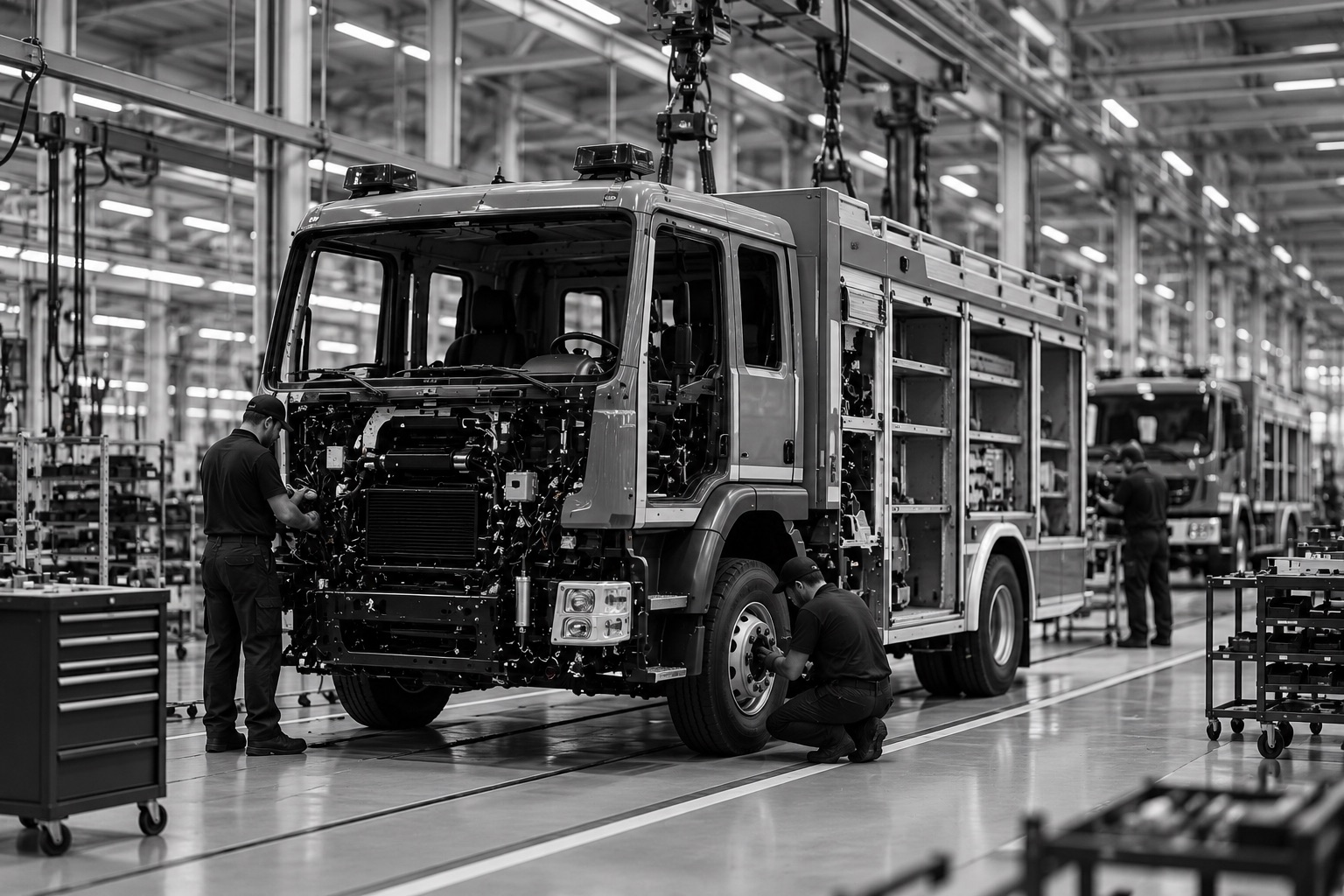
Fire apparatus on the assembly line

Same chassis, same body, same customer type. The margin depends on who configured it.

01The spread

± 5 pts of margin between two reps

Margin dispersion measured between people on comparable work, same configuration, same customer type.

Where each rep's margin lands against the median comparable deal
− 5 ptsmedian deal+ 5 pts

02The leaks

− 2 pts of margin per deal

Lost silently, order after order, from avoidable options and inconsistent decisions:

Over-equipping

A heavier chassis or an extra option added to be safe.

Inconsistent discounts

Fleet deals priced from memory, not from comparable orders.
One tender, step by step

What changes on a tender, step by step.

Step 1 of 4
Today
Hours reading specifications, annexes and contractual documents
Homologation rules, equipment lists and delivery penalties, read line by line. Hours per complex tender.
With Steero
A traceable requirement map in minutes, every answer linked to its source
Every requirement extracted, classified and tied to the page it came from. Under twenty minutes.
How it runs

Your commercial rules reach every offer, and every offer makes them sharper.

You set the rules. Steero applies them on every tender.

01

Strategy hub

Where your pricing corridors (the price range allowed for each segment), option rules and the reasoning of your best sellers are written down and validated, before any rep sees them.
Pricing corridors by segment
Product and option rules
Negotiation playbook
Owned by Sales Director Product Pricing
Rule goes out Guidance Outcome comes back Corridor · Fleet ≤ 10 Config · Nothing extra Won · 12% disc.
A validated rule goes out
03

Learning loop

Every won or lost tender comes back and sharpens the rules.
02

AI sales assistant

What the rep or the bid team sees on each tender, in the 30 seconds before a number is sent.
Minimum compliant configuration
Price corridor with comparables
Arguments to defend the offer
Used by Sales team Tender team
What it moves

What it moves on your P&L.

Typical yearly impact for a manufacturer delivering 1,000 vehicles a year
EUR 10M
of gross profit per 1,000 units a year
+ 2 pts
on a EUR 500,000 vehicle is EUR 10,000, on every unit

Gross profit

The same configuration logic and discount discipline on every bid, in every branch.

Cost to sell

Complex tender analysis from roughly 2 hours to under 20 minutes.

Win rate uplift

Compliant, sharper-priced offers win more often, from the same team.

Return

4x ROI, payback in under four months.

Estimate it on your case Two minutes, your own revenue and margin figures.
Path to success

Small scope. First results fast. Then the whole organisation.

01 now

Discover

One session, on your documents.

Twenty minutes, one recent tender
Steero shown on your documents
You decide whether to pilot
02 3 months

Prove

A narrow pilot, measured with Finance.

One range, one market, 3 to 5 users
You bring option rules, past bids, tenders
Margin and win rate measured with Finance
03 upon success

Scale

Roll-out once the reps ask for it.

Roll-out to every bid team
Extension to other markets and ranges
Price agreed upfront; CPQ unchanged
What we need from you
Real tenders and negotiated deals, with the answer you would consider a good one
Option and compatibility rules for chassis, body and equipment
One or two sellers or bid managers who want to try it early
Questions we get

Before your team asks.

The four questions that come up in every first conversation with a special vehicle manufacturer.

No. You keep both. Your CPQ decides what a rep is allowed to configure and inside which price band. Your CRM tells you where the deal stands. Neither one helps the rep at the moment they actually have to pick a number and defend it. That’s the bit we cover. We plug into the stack you already run, read the configuration from it, and push the reasoning back so it doesn’t disappear into someone’s head. Eight weeks to deploy. And if part of your pricing still lives in Excel, that’s fine, it usually does.

You do. We don’t arrive with our own pricing theory. We take the corridors your pricing team already set, add the way your strongest sellers reason inside them, and put that in front of everyone else. Your Sales Excellence or Pricing people validate every rule before a single rep sees it. Later, once deals come back with results attached, Steero will suggest changes. Suggest. Someone on your side still decides.

Both work. Standard vehicles sit with reps who argue the price back and forth with a fleet manager. Framework agreements and public tenders sit with a bid team that sends one number and then waits. Two different jobs under two different kinds of pressure. Same engine underneath, different screen in front of it. Most of our special vehicle work runs both at once inside the same company.

We look backwards before we look forwards. Give us 12 to 24 months of quotes and we’ll show you what your own people did with comparable configurations: who priced where, how wide the spread got, what it cost you. You see that number before committing to anything, and your finance team is welcome to pull the calculation apart. If they don’t buy it, there’s no reason to go further. Rollout comes after, on whatever scope you pick, measured against a group who isn’t using it.

Bring one recent tender.
We'll show you the margin you're not tracking.

Book 20 minutes