The Silent
Margin Leak
How industrial deals are really priced, won and lost.


A Steero field report on how industrial deals are really priced, won and lost, from the reps who set the number.
Contents
A field report, from what the sales desk actually sounds like to the system that learns from every deal.
In this edition, we read our field verbatims against the unconventional truths of the book The Challenger Sale (Dixon & Adamson), reference that showed the best B2B reps win by teaching, tailoring and taking control rather than by building relationships.
This isn't desk research stitched together from public sources. It comes straight from the sales desk, from the reps building the offer and the leaders who own the margin. We built it from our own corpus of interviews inside configured-industrial-sales organisations: 60 industrial organisations and 160+ interview sessions across elevators, waste equipment, hydraulics, additive manufacturing, glass, chemicals and polymers, medtech, heavy equipment and workplace products. The companies differed wildly. The operating problem repeated. That repetition is the finding.

Three numbers from the field
“We have sales reps that can sell 20X the bottom 20%… very seldom you see a newcomer in the top.”
How wide rep discount authority runs, country to country, inside the same company.
The leakage he feels but cannot measure: “the buyer who annoys the seller one last time before signing.”
Manufacturers think they have a discounting problem. They have a variance of execution problem: the last big margin lever no system governs.
Industrial deals don't leak margin on price lists or product gaps. They leak in the live moments where commercial judgment is applied. And that judgment varies more, rep to rep, than any leader can currently see or govern.
Industrial sales doesn't have an information problem. It has a decision-support problem. Reps already drown in CRM, CPQ and BI. They don't need another dashboard; they need a suggestion, in the moment, before the number. For a decade the industry confused business intelligence with decision support, and built the first when only the second changes behaviour.
Put it as an equation:
Pricing teams and CPQ own the first variable. Nobody owns the other two. That's why discount authority can range from 2% to 20% inside one company, why 80% of deals escalate anyway, and why the top of a sales force outsells the bottom twenty-fold. The gap isn't noise. It's the fingerprint of judgment made under pressure, without context or memory.
Manufacturers have spent years improving the systems around revenue: CRM, CPQ, ERP, pricing analytics, training, dashboards. The biggest margin lever still has no system behind it: the quality of commercial judgment in the moments a deal is shaped. Does the rep challenge the spec? Where do they anchor? Which concession do they trade? When do they escalate? This is also where reps, regions and countries differ most.
Two voices at the same heavy industrial machine manufacturer put the economics in plain language. A sales rep, on finding the perfect price point:
“What I would like to know is statistically how far I need to go down, but without losing more than necessary, to find that perfect point. If I go down one euro, I win it. But if I go down two, I also win it, but I have lost one euro.”
An area sales director, on what wide corridors do to anchoring:
“I don't like that our sales teams have 20% space… will I give 17 or 18? Maybe I just go 18–19. This is the part where I think we might lose Euros.”
The hidden issue is not only discounting. It is execution variance in commercial judgment. CRM records the deal. CPQ configures the offer. ERP fulfils the order. Training transfers knowledge periodically. None of them governs how a rep thinks in the live moment.
The Challenger Sale put a number on why this matters. In complex B2B, “over half of customer loyalty is a result not of what you sell, but how you sell” (53%), while “only 9 percent… is attributable to price-to-value ratio.” The live judgment above is the “how you sell.”
Why the prize is large: a 1% price increase lifts operating profit by about 8.7%, with no volume loss (McKinsey). A $15bn B2B distributor pairing analytical and agentic AI pricing reported over 250bps of margin uplift (McKinsey). We use these to size the prize, not to headline it. Anyone can cite them. The headline numbers here are our own.
| Commercial movement | Profit impact |
|---|---|
| 1% price increase | ~8.7% operating-profit increase, no volume loss |
| AI pricing transformation (one $15bn B2B distributor) | >200 bps margin improvement over 18 months |
| Agentic AI layered on top (same distributor) | ~50 bps additional opportunity identified in 10 weeks |
The silent margin leak
Leakage rarely looks dramatic. It looks like sensible judgment. A rep trims because the buyer pushes. A seller skips the challenge because the tender is due. A region applies its own discount norm. A junior over-complies with a spec. A senior wins by reading customer history, but the reasoning never leaves their head. In configured industrial sales, none of these are small. They sit on gross margin. We keep seeing five leakage zones.
Incomplete or contradictory requirements
The gap between average and top sellers isn't product knowledge. It's knowing which contradictions matter commercially.
“I scan the customer specs in two minutes and can identify the leverage points.”
“It actually suits me when there are errors, because I can correct them. It increases my credibility.”
Meanwhile, the rest of the team reads the same document differently:
“Average reps spend endless time on parameters that don't impact anything.”
the loss isn't a bad system. It's a weaker human reading of identical facts.
the edge is teaching the customer which contradiction matters. As the book puts it, the question is “what data, information, or insight can you put in front of your customer that reframes the way they think about their business?”
Prescription, executed inconsistently
The best sellers shape specs rather than just respond to them, and the most profitable action happens before the visible sales event. A sales rep runs an entire pre-tender playbook. He hands clients ready-made spec templates seeded with criteria that favour him, prices against the quantity schedule rather than the unit price list, and reads rivals' specs for “pots de bananes”, the traps a competitor buried in the tender. Even the anonymous Q&A round becomes a competitive-intelligence tool. The goal, in his team's words, isn't to quote a price at all:
“It's to convince him to write his tender with criteria that suit us and don't suit the competition.”
And here's the catch: that playbook lives in one head: undocumented, and impossible to pass on. Ask him how he picks which tenders to chase and the method dissolves: “c'est un peu empirique… dans son intime conviction”, a bit empirical, down to gut conviction (waste-equipment manufacturer, senior sales rep).
inconsistent prescription leaks margin before any negotiation, and the best version of it currently lives in one rep's head.
prescription is, almost word for word, the book's “sweet spot of customer loyalty is outperforming your competitors on those things you've taught your customers are important.” Skip it and “all you've really done is provide free consulting.”
Late concessions, untraded
“We cannot estimate our leakage… but 3 to 5 percent feels rational, like the buyer who annoys the seller one last time before signing, and you get crushed by 3 percent.”
the problem isn't that reps discount. It's that the rationale dies at close, so the company never learns what the euro bought.
this is the Relationship-Builder reflex the book warns against. Defuse the tension, give the point. The Challenger move “doesn't give in to the request for a 10 percent discount, but brings the conversation back to… value, rather than price.”
History exists, but isn't converted into discipline
The senior rep prices by exploiting the gap between a client's estimated volumes and their real ones. It's a genuine margin lever, and it requires deep client history. No system captures the logic, so juniors can't replicate it.
“I always look at the customer's history.”
And when the customer is new, with no history to read?
“It is 100 percent intuition.”
the data is present; the reasoning on it isn't standardised. Seniors reconstruct, juniors guess, managers see outcomes but never the reasoning.
tailoring “relies on the rep's knowledge of the specific business priorities of whomever he or she is talking to.” Seniors tailor from memory; juniors can't. The behaviour is real but unevenly applied and never captured.
Weak versus strong discovery
“The bad rep asks: metal or polymer? small or medium? what's your budget? That's it. The good rep first finds out what type of customer this is, an F1 team versus a hospital, and gets closer to the specific pain.”
And what weak discovery looks like from the inside:
“Sitting in the office creating tenders and hoping some miracle happens.”
variance starts at diagnosis, not price. A misclassified customer is mispriced before anyone talks money.
the reaction to aim for is “Huh, I never thought of it that way before,” not agreement. Diagnosis precedes price, and it's where the gap between the bad rep and the good rep opens first.
| Field data point | What it reveals |
|---|---|
| Top reps sell 20× the bottom 20% | The gap is tacit knowledge, not process, and there's no systematic coaching |
| Discount authority spans 2% to 20% by country | Wide corridors make reps anchor high “to be safe” |
| ~80% of deals escalate to manager approval | The corridor system produces exceptions, not discipline |
| 75% of sales-cycle time goes to tendering; a 30-minute task becomes a week-long backlog | Guidance must arrive during the tender cycle, not after |
| One product's price list: 5,346 rows; the simplified market-based pilot: 227 | Complexity is a design choice, and reps navigate the unsimplified version daily |
| “Directors say: we don't do pricing. We do budget… if my target is 20%, I'll set it at 30%, then I have 10% discount to reach the 20” | Prices are set backwards from budgets, not from willingness to pay |
Why the current stack doesn't fix it
The revenue stack was never built to govern live judgment.
CRM records; it doesn't improve judgment before the number is committed.
“For now, I have zero CRM. I only have WhatsApp. If you ask a rep to enter extra feedback, they'll say: ‘I'm not doing that.’”
CPQ configures; it doesn't govern reasoning. Margin moves before and after the mechanical step. And when the configurator throws an error, it doesn't explain how to fix it. Reps call a colleague or walk to a desk.
“We need a simple system that is not at the end, but live.”
ERP fulfils and controls; it doesn't explain willingness to pay. Budget-based pricing fills the vacuum: conservative prices set backwards from targets, padded for the discount to come (elevator manufacturer, area sales director).
Training transfers knowledge episodically; it doesn't ensure application under pressure.
“We shared some best-practices, but some reps said: ‘For this customer, that just doesn't work.’”
Static playbooks describe intent; they don't adapt to the deal. Ask a top rep to write his pricing logic down as rules, and he can't:
“If I had a general rule, I'd prohibit it for the other reps. It's always a decision matrix.”
This is the Challenger paradox in the field. The book's own model, “teach, tailor, and take control… through… constructive tension,” is the right behaviour. But trained once, it decays the moment a real deal doesn't fit the script.
And the learning loop is broken. Win/loss data exists. The analytics exist. Yet extracting a behavioural pattern still takes a manual deep-dive, and the insights die in Excel without ever reaching the next live deal (elevator manufacturer, pricing lead).
Every system records or configures the deal. None governs how the rep thinks in the live moment. That gap is the leak.
| Layer | Does well | Doesn't govern | Where leakage appears |
|---|---|---|---|
| CRM | Records accounts, opportunities, outcomes | How the rep thinks before pricing | Missing rationale, delayed learning |
| CPQ | Configures products, mechanical pricing | Whether offer strategy is intelligent | Over-compliance, wrong options, default max discount |
| ERP | Cost, order, finance, fulfilment | Willingness to pay, negotiation posture | Price logic divorced from context |
| Training | Transfers frameworks episodically | Whether logic is applied live | Methodology decay, local workarounds |
| Static playbooks | Define intended behaviour | Conditional application, learning | Rules ignored, top-rep logic uncaptured |
| Execution-quality layer | Structures live reasoning + learning | (shouldn't replace judgment or own transactional systems) | Turns variance into an improvable layer |
Complexity is the reason, not the exception
“Our deals are too complex for a system” is real but backwards. These single-company facts argue against a generic AI layer and for a governed, domain-specific one. They also explain why the Challenger advantage is widest here: in complex sales, the book found, Relationship Builders “nearly fall off the map entirely.”
| Context | Field data point | What it reveals |
|---|---|---|
| Glass manufacturer | 17,000 active articles in one BU; 6-week quotes; 180-page specs | Autonomous pricing unsafe; context capture essential |
| Hydraulics manufacturer | 3-year RFQ-to-series cycle; impact ~5 years out | Learning loops break when outcomes arrive years later |
| Industrial automation | 9 BUs, 9 sales orgs, 500M pricing lines in 2 years | “Just connect everything” isn't a starting point |
| Workplace-products manufacturer | 80,000 model codes; 7-person pricing team; 85% large / 15% small | Mature pricing teams still lack live capture |
| Mining-equipment business | Aggregates €200k–€300k (cycles to 1yr); mining €1M–€20M (2–15yrs) | One company, several operating models |
| Elevator manufacturer | 80–200+ configuration parameters per product; 5,346-row price lists | Complexity lands on the rep at the worst moment: mid-quote |
Complexity isn't the case against governing judgment. It's proof that judgment is where the money is, and why a generic tool fails.
What good looks like
The missing layer is execution quality. It shapes how reps prepare, diagnose, frame value, defend price, trade concessions and learn. It isn't enablement (episodic), CRM (records), CPQ (configures) or analytics (assumes the decision is already made). It sits between the rep's judgment and the systems, sharpening the decision as it's made. Every company we met already runs a hand-built version (the expert duo, the pricing committee, the manual Excel, the post-deal debrief), just not scalable, timely or closed-loop.
1Frontline guidance. A sparring partner, not a chatbot. It forces the questions top performers ask automatically.
“We want to instil the thought: every option you change makes your hit rate improve or worsen.”
2Central excellence hub. Most companies already hold the knowledge, scattered across PowerPoint, PDF, SharePoint, Teams and wikis. As one sales development lead at an elevator manufacturer put it, “documentation exists but no one knows where it's located.” The job is making it available at the point of decision, with room for local exceptions that don't break central discipline.
3Continuous learning engine. It captures what happened and why, close enough to the interaction to be accurate, and light enough that reps actually use it. The field brief was blunt: the signal hides, memory fades, and nobody scrolls.
“Each sales rep interaction with the tool should generate signals to refine the commercial strategy. This would help us to stay close to our market.”
| Operating question | Frontline need | Leadership need | Learning need |
|---|---|---|---|
| Understand the deal | Extract context, specs, prior deals, value drivers | Define what context matters by segment | Learn which signals predict win/margin |
| Shape the offer | Identify config risks, variants, sweet spots | Define product/segment logic | Learn where deviations improve outcomes |
| Defend price | Prepare arguments, trade-offs, concession posture | Set guardrails and escalation logic | Learn which concessions were traded vs given |
| Negotiate | Simulate objections, next-best moves | Monitor discount/approval exceptions | Update playbooks from outcomes |
| Learn | Capture rationale with minimal friction | See variance by team, geo, product, stage | Turn exceptions into improved rules |
Why now: governed reasoning, not autonomous pricing
The field was explicit on the risk:
“We need to guarantee zero hallucination, because a deal can be expensive.”
One glass manufacturer tried custom AI pricing and “failed miserably” on a complex portfolio (glass manufacturer, commercial leader). A chemicals-group pricing expert warned that European teams can't freely store competitors' exact prices unless they're public, so they work in ranges (“outpriced,” “within range,” “below competition”). The next layer isn't autonomous pricing. It's governed commercial reasoning, with source traceability, customer-owned knowledge, and human review.
Three things are newly practical: AI can extract context from messy inputs, guide the rep in the workflow, and close the learning loop. The market agrees.
Firms that treat this as a tool deployment get another workflow. Firms that treat it as an execution-quality layer compound learning across every deal.
How to start
Not with a transformation programme. With a narrow, high-friction, high-learning slice. Start with a diagnostic, not a deployment: take 10–20 recent deals in one repeatable segment, compare the formal process with what actually happened, and look for four gaps (reps reason differently, concessions go untraded, context goes missing, rationale disappears). Then build one lightweight guidance loop around a single decision moment. Don't touch CRM, CPQ or ERP. A 6–8 week start answers four questions. Can you define the logic top performers use? Can you deliver it without admin burden? Can you capture rationale to improve it? Can you show leaders where variance helps or hurts margin?
| Component | Design choice | Why it de-risks |
|---|---|---|
| Scope | One product family, one region, one motion | Avoids group-wide transformation |
| Data | 10–20 recent deals, playbooks, pricing rules, win/loss notes | Starts from existing knowledge |
| Rep workflow | Guidance at one moment: prescription, discount justification, config challenge, or negotiation prep | Limits change management; gives a before/after |
| Leadership workflow | Weekly review of variance and rule exceptions | Makes field behaviour a management object |
| Success metrics | Adoption, time-to-prepare, rationale quality, discount discipline, margin movement | Measures behaviour and economics |
| Expansion condition | Expand only on proven decision-quality lift | Prevents “AI initiative” sprawl |
Is execution variance leaking your margin? Six questions
Tap to checkIf these are hard to answer, the issue may not be discounting, training or CRM adoption. It may be execution variance. And that is no longer an unavoidable feature of industrial sales. It is now an operating layer to build.
Methodology & scope
This report stands on Steero's own user-research corpus, not public sources.
60 industrial organisations · 160+ interview sessions with commercial leaders and front-line reps, logged in our User Research Repository.
Both sides of every deal: the leaders who own the margin and the reps who set the number.
Europe-weighted, with a strong French and DACH base. Verticals span:
Every field quote is attributed by vertical and role (for example, “elevator manufacturer, sales rep”) and traces to a specific interview in the repository. Quotes originally in French or German are translated. Company names are withheld. Quantitative field points (splits, corridor widths, escalation rates) are single-company facts, labelled as such, not market benchmarks.
The corpus over-represents companies curious enough about their own commercial execution to talk to us. Session depth varies from 30-minute discoveries to multi-hour working sessions. Where an interviewee estimated a number (“3 to 5 percent feels rational”), we report it as an estimate, not a measurement.
Challenger callouts quote The Challenger Sale: Taking Control of the Customer Conversation, Matthew Dixon & Brent Adamson (2011). The Mobiliser model belongs to the sequel, The Challenger Customer, and is out of scope.
Steero, the company behind this report
This report is published by Steero. We wrote it because we live the problem with our customers every day, and because we are building the execution-quality layer it describes.
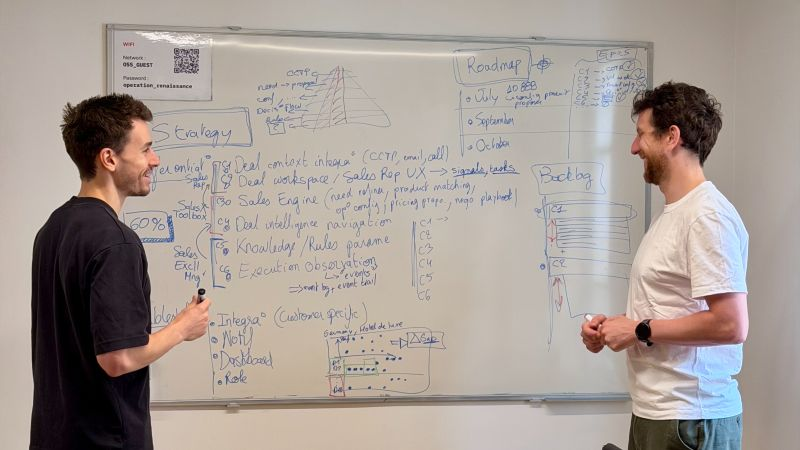
Steero is an AI-native Sales Excellence platform for industrial manufacturers. It is the execution-quality layer this report describes, made real. It sits in front of the quote, where the real commercial decision happens, and gives every rep the move your best 10–15% would make: the right product, the right price corridor, the right negotiation posture. CRM records the deal. CPQ configures the offer. Steero protects the decision in between.

Jacques spent ten years in B2B sales on complex products before founding Steero. The company comes straight out of what he kept seeing in the field: a small minority of reps consistently close and protect margin where everyone else leaks it, and that edge is not charisma. It is capturable knowledge. He is building Steero with OSS Ventures.
In every sales team, a handful of reps win the deals and protect the margin that everyone else gives away. We spent a decade watching it happen. That edge looks like instinct. It isn't. It's knowledge: how the best reps read a deal, where they anchor, which concession they trade, when they hold the line.
Knowledge can be captured, and once captured, it can belong to everyone. Not as a dashboard after the quarter or a training once a year, but as one sharp suggestion in the thirty seconds before a rep commits to a number. That is Steero: the judgment of your best people, made explicit and put in front of every rep at the exact moment margin is won or lost.
We are not here to replace the salesperson. We are here to make every salesperson sell like your best one.
| Pillar | What it is | Maps to |
|---|---|---|
| Deal Intelligence | Unifies CRM history, CPQ outputs, tender specs, pricing rules, offer files, emails, competitive intel and win/loss data; clusters comparable deals and surfaces the next best move | Frontline guidance |
| Encoded Expertise | Turns top-rep logic and Sales Excellence rules (pricing corridors, product fit, competitor plays) into live recommendations | Central excellence hub |
| Continuous Learning | Every outcome sharpens the guidance for the next comparable deal | Learning engine |
Steero proves value on historical backtests first, then deploys with live reps in 8 weeks. No ERP change, no rep surveillance.
won deals over-discounted by more than 2 points versus comparable won deals
One backtest · global elevator manufacturer€1.27M → €1.51M
margin today → realistic case uplift
modelled from backtest, not yet realised livemargin points per deal
a target, not yet a live-deployment resultCo-built with OSS Ventures, the industrial venture studio behind 20+ startups in six years. OSS brings the thesis, industrial reach and capital; Jacques brings the domain and the build.


Want to see your own leak?
8-week opportunity scan. No ERP change. No rep surveillance. We connect your deal context, backtest your historical quotes, and show the margin buried in your live pipeline, before asking a single rep to change behaviour.
From the Sales Desk is Steero's ongoing report series on the reality of industrial sales execution, built from our own corpus of interviews and deal backtests, never from public-source desk research. If it didn't come from someone who lives the deal, it isn't in here.
This edition: No. 01, The Silent Margin Leak.
Margin isn't lost in the price list. It's lost at the sales desk, in the thirty seconds before a rep commits to a number.
 Published by Steero · Co-built with OSS Ventures · Written from the sales desk